

Recognizing Art Deco does not take a long description. Sharp geometry, metal that catches the light, deep-toned wood and an almost flawless symmetry give it away at once. Stretching from the mid-1920s to the late 1930s, from skyscraper lobbies to movie theaters and from ocean liners to executive offices, this language was the self-assured face of a new age.
Today, Art Deco often brings to mind gold-leaf ceilings and lavish opulence. Yet the finest examples of the style use ornament with discipline. Understanding that discipline also shows how a restrained touch of Art Deco can be brought into today’s executive office.
From Paris 1925 to the lobbies of New York
The style takes its name from the International Exhibition of Modern Decorative and Industrial Arts, held in Paris in 1925. The name was rarely used at the time; the style was more often simply called “modern.” The term Art Deco became widespread in the 1960s, when retrospective interest in the style grew. At the exhibition, furniture makers, glass and metal craftsmen and lacquer artists were pursuing the same idea: bringing the refinement of handcraft together with the clean, decisive lines of a new age. The fragmented geometry of Cubism, the fascination with Egypt revived by the discovery of Tutankhamun’s tomb in 1922, and the rhythm of the machine were the main sources of this language.
When the style crossed the Atlantic, its scale changed. In New York, the Chrysler Building, completed in 1930, and the Empire State Building, opened a year later, carried Art Deco into the city’s skyline. The real show, however, often took place in the lobby. Visitors coming through the door were greeted by marble-clad walls, gleaming metal elevator doors and lines flowing upward.
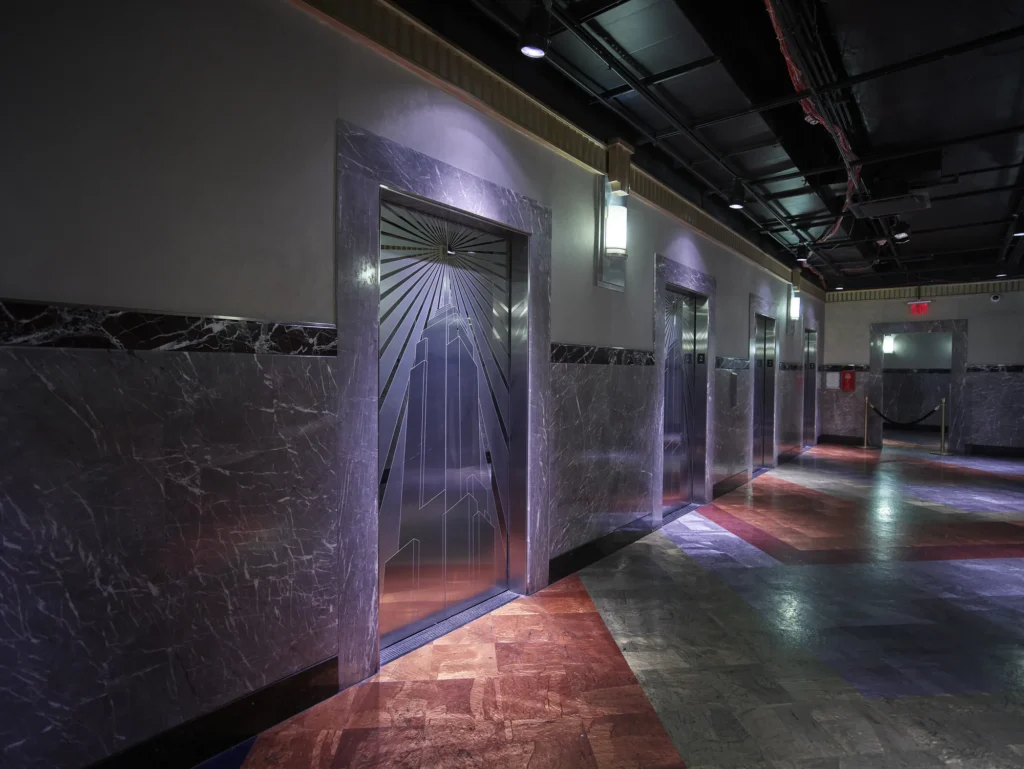
These lobbies expressed how a company saw itself. The quality of the materials stood for trust, symmetry for order and vertical lines for ascent. For building owners, the lobby was less a passageway than a business card made of stone and metal.
The language of geometry
What makes Art Deco recognizable at a glance is the way it turns ornament into geometry. Zigzags, broken lines, stepped forms and sunbursts radiating from a center make up the alphabet of the style. Stepped silhouettes evoke the tiered masses of skyscrapers, while sunbursts suggest energy and optimism.
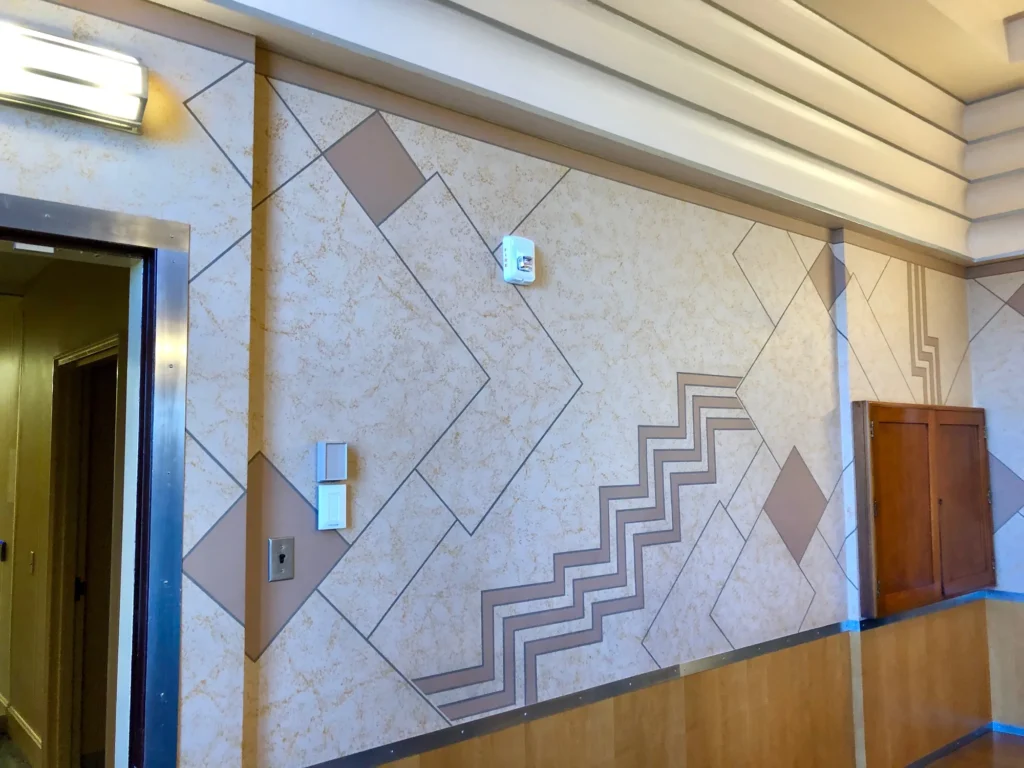
The strength of these motifs lies in repetition and symmetry. The same rhythm continues across a wall panel, a door handle or the edge of a ceiling, so the space looks unified rather than scattered. At Cincinnati Union Terminal, the stepped patterns running the full length of the wall in the secretarial area of the president’s office show how calm and orderly a rhythm like this can be. The pattern is strong but the colors are soft; the eye follows the rhythm without tiring.
Lighting is also part of this language. Frosted glass sconces, indirect light hidden in stepped ceiling bands and metal-framed fixtures complete the geometry with light. The light never strikes the eye directly; it reflects off surfaces, gently filling the space and bringing out the texture of the materials.
Precious woods, lacquer and metal
In Art Deco, luxury comes from the material itself. The most sought-after surfaces of the period were figured wood veneers such as Macassar ebony and amboyna, deep-gloss lacquer, brass, bronze and chrome. The French designer Émile-Jacques Ruhlmann is one of the emblematic names of this approach. His furniture brought together flawless veneer work, legs tapering toward the floor and small, carefully considered details.
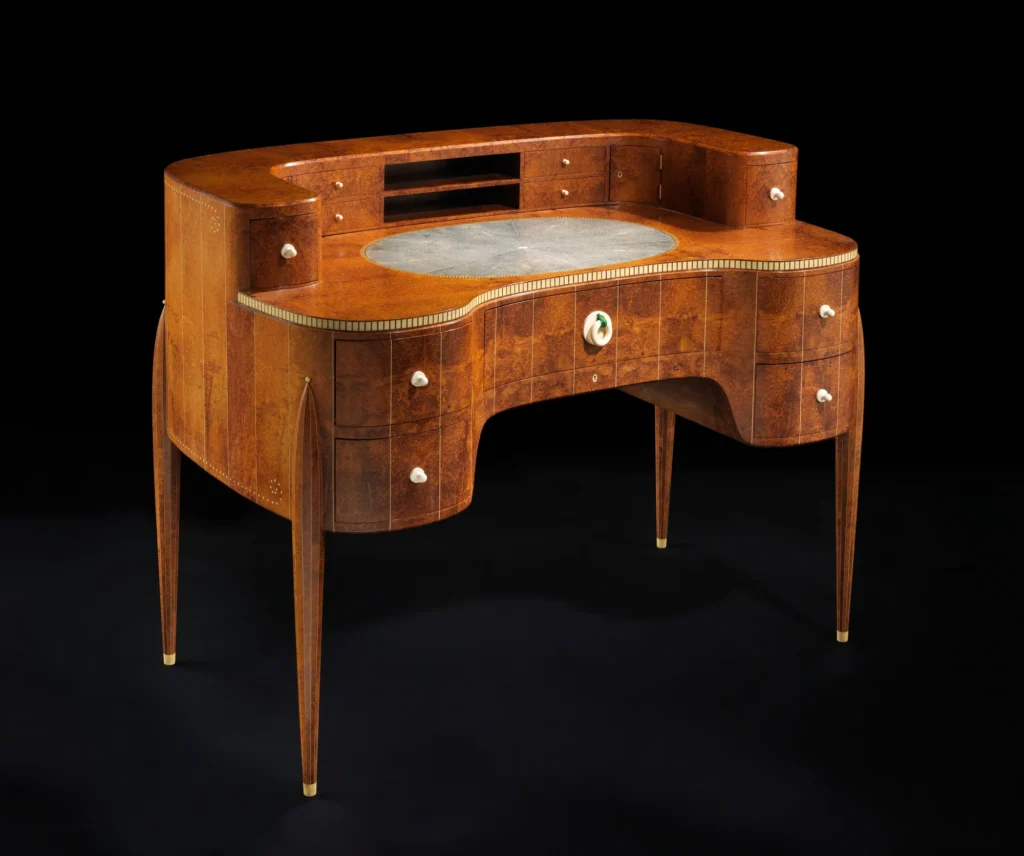
Ruhlmann’s David-Weill desk, dated to 1918-19 and now in the Metropolitan Museum of Art in New York, is a fine example of this mastery, with its amboyna-veneered body, ivory details and use of sharkskin. On the lacquer side, the name that stands out is Jean Dunand; lacquer applied in coat after coat gave the surface a deep, glass-like sheen.
What these materials have in common is their relationship with light. Polished wood reflects light with a soft warmth, metal with a sharp gleam. In a good Art Deco space the two balance each other: one brings warmth, the other clarity. That is why, the more pronounced the grain of the wood, the slimmer the metal and the more sparingly it is used.
From the lobby to the executive office
The grandeur of the lobby comes down to a more personal scale in the executive offices on the building’s upper floors. The president’s office at Cincinnati Union Terminal, which opened in 1933, is one of the striking examples of this. The wood paneling wrapping the curved walls, the map of the United States worked in woods of different tones above the fireplace, the built-in bookcase and the desk with its rounded lines are all parts of the same design idea. Here the line between furniture and architecture almost disappears; the bookcase reads as a continuation of the wall, and the desk as a continuation of the room’s curve.
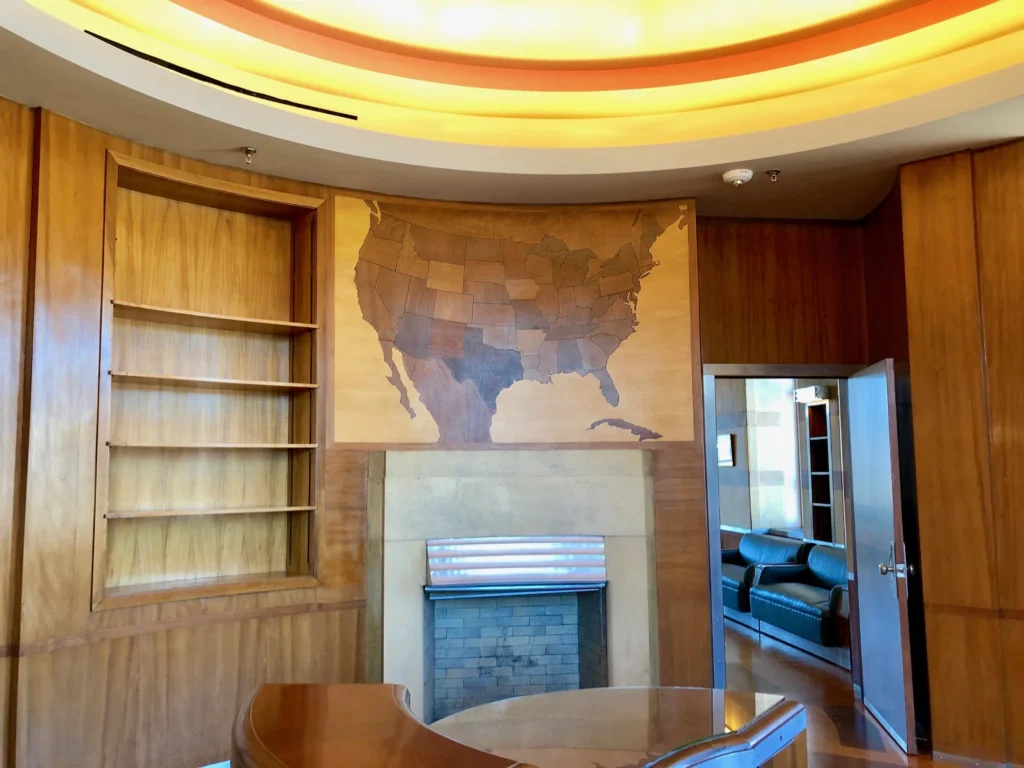
What stands out here is how carefully the ornament is controlled. Most of the surfaces are plain wood, while geometry shows itself in the ceiling bands and a few metal details. Color is used with the same restraint; the honey tones of the wood and the warm bands on the ceiling read as parts of a single palette. The room looks rich but not tiring. Visitors sense authority but are not met with ostentation. This balance is still a valid lesson for an executive office today.
A restrained Art Deco for today’s executive office
Bringing Art Deco into the present does not mean building a period set. The effect can be captured with a handful of the right choices. A figured walnut veneer desktop, a slim metal profile or a gently curving body line can carry the spirit of the style on its own.
Symmetry is the most powerful tool here. A cabinet centered behind the desk, lighting placed in balance on either side and a calm floor give the room Art Deco’s sense of order. Rather than combining zigzags, sunbursts and stepped forms in the same room, choosing a single motif makes the result more elegant. Metal details gain value when they are few; on a dark surface, a single brass handle is often accent enough. A frosted glass sconce or indirect ceiling light also recalls the period without loudly imitating it.
Born in Paris a century ago and reaching its peak in skyscraper lobbies, this language has learned to speak more quietly today. A balanced combination of walnut, anthracite and metal is one of the most natural ways to bring Art Deco’s restrained grandeur into today’s executive office and the work corner at home.